Investing is a powerful tool for growing wealth, but not all investment strategies are the same. Two of the most common approaches are active and passive investing. Understanding their differences, advantages, and risks helps investors make informed decisions based on goals, risk tolerance, and market knowledge.
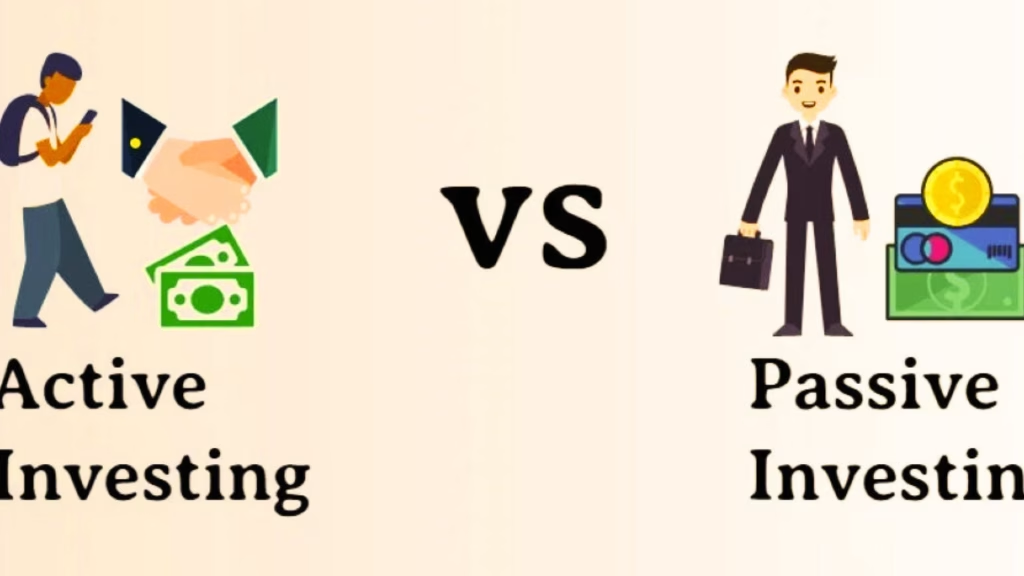
What Is Active Investing?
Active investing involves a hands-on approach, where fund managers or individual investors attempt to outperform the market by selecting specific securities. This strategy relies on research, analysis, and market timing to achieve higher returns.
Key features of active investing:
- Research-driven: Investors analyze company fundamentals, market trends, and economic indicators.
- Frequent trading: Buying and selling securities regularly to take advantage of price movements.
- Goal-oriented: Aims to beat a benchmark index, such as the S&P 500.
- Flexibility: Managers can adjust portfolios quickly in response to market conditions.
Advantages of Active Investing
- Potential for higher returns compared to the market average.
- Ability to respond to market changes and capitalize on opportunities.
- Can focus on sectors or companies with growth potential.
Challenges of Active Investing
- Higher fees due to management and trading costs.
- Increased risk from frequent trades and reliance on market predictions.
- Requires significant time, expertise, and research.
What Is Passive Investing?
Passive investing is a strategy designed to replicate the performance of a market index rather than outperform it. It focuses on long-term growth and minimizing trading activity.
Key features of passive investing:
- Index-based: Investments track indices like the S&P 500, NASDAQ, or Dow Jones.
- Low management fees: Less active trading reduces costs.
- Long-term focus: Minimal buying and selling, emphasizing growth over time.
- Consistency: Market returns are generally achieved without attempting to beat the market.
Advantages of Passive Investing
- Lower fees and transaction costs.
- Reduced risk from market timing and short-term fluctuations.
- Ideal for investors seeking steady, long-term growth with minimal involvement.
You Can Also Read: inflation-savings-purchasing-power
Challenges of Passive Investing
- Limited ability to outperform the market.
- Returns are tied directly to market performance, including downturns.
- Less flexibility to capitalize on short-term market opportunities.
Key Differences Between Active and Passive Investing
| Feature | Active Investing | Passive Investing |
| Objective | Beat the market | Match the market |
| Strategy | Frequent trading, market timing | Long-term holding, index tracking |
| Fees | Higher due to active management | Lower, minimal management costs |
| Risk | Higher due to market timing and stock selection | Lower, market risk only |
| Control | High, investors select securities | Low, follows index composition |
| Time Commitment | Significant, requires research and monitoring | Minimal, set-and-forget approach |
Which Strategy Is Right for You?
The choice between active and passive investing depends on:
- Risk tolerance: Active investing is better for those comfortable with higher risk for potentially higher returns, while passive investing suits conservative investors.
- Time and expertise: Active investing requires knowledge, research, and monitoring, whereas passive investing is easier for beginners.
- Financial goals: Short-term goals may benefit from active management, while long-term wealth accumulation is well-suited to passive strategies.
Many investors combine both approaches to balance risk and opportunity, using active strategies for specific sectors or stocks while maintaining a passive index-based core portfolio.
Conclusion
Active and passive investing represent two distinct paths to growing wealth. Active investing offers the potential for higher returns through hands-on management and market timing, but it comes with higher risk and costs. Passive investing emphasizes long-term stability, lower fees, and market-matching returns. Understanding these differences allows investors to align their strategy with personal goals, risk tolerance, and available time.
For guidance on investment strategies, portfolio management, and financial planning, platforms like Callscroll provide actionable insights and resources to help investors make informed decisions and optimize long-term growth.